Every business owner faces this question at least once a year: Should I raise my prices?
In 2026, with costs creeping up and competitors adjusting their pricing, the question hits different. Raise them too much, you lose customers. Don’t raise them enough, your margins get squeezed. Stand still, and inflation eats your profit.
Here’s the thing: you don’t need to guess. The break-even formula gives you a clear, numbers-based answer. It shows you exactly how many sales you need at your current price versus a new price: and whether that increase actually makes sense for your business.
Let’s break it down.
What the break-even formula actually tells you
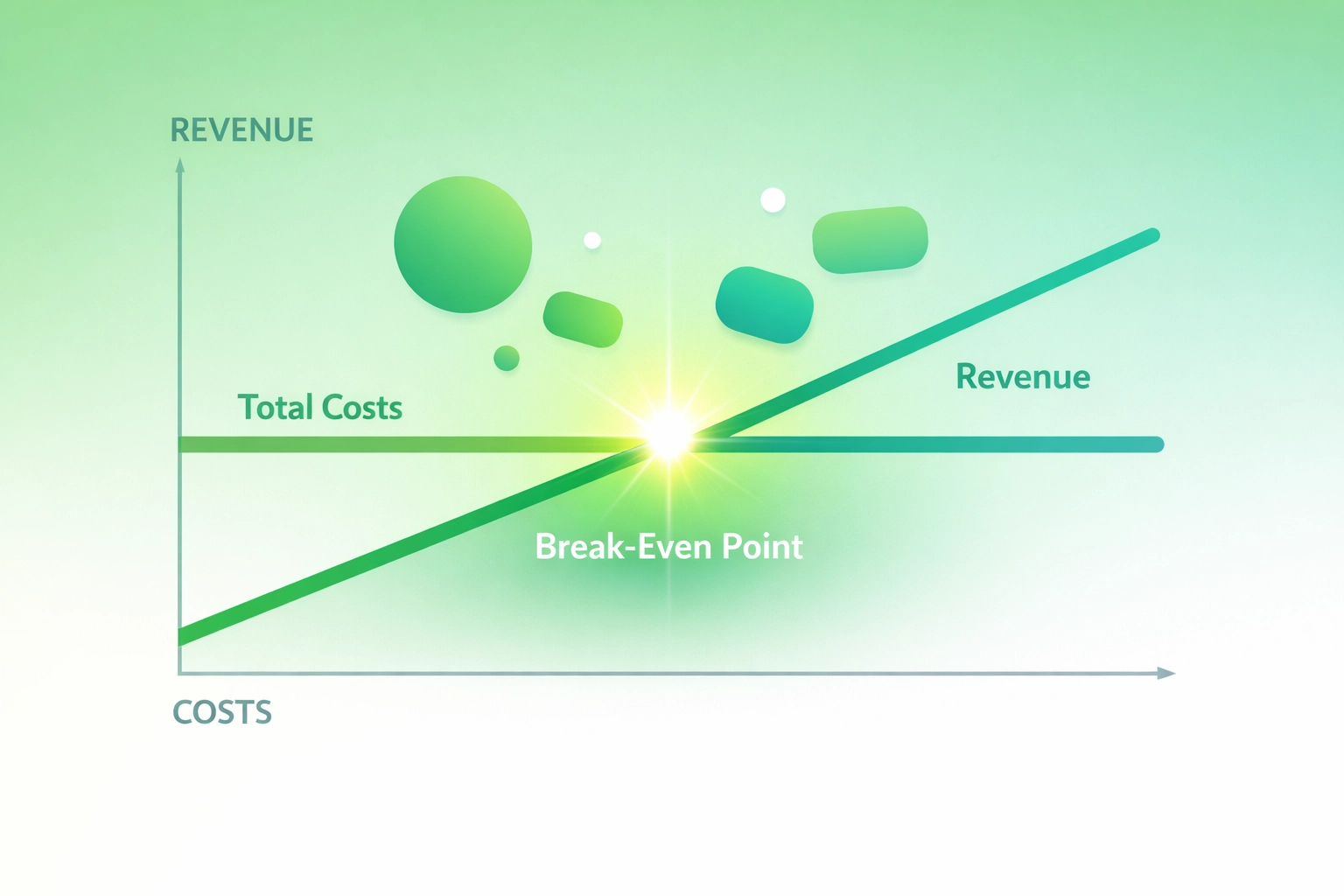
The break-even point is the moment your revenue covers all costs: both fixed and variable: with zero profit. Not exciting, but essential.
The formula:
Break-Even Point (units) = Fixed Costs ÷ (Price per Unit – Variable Cost per Unit)
Translation: How many units do you need to sell to stop losing money?
The magic happens in that second part: (Price – Variable Cost). That’s your contribution margin: the money each sale contributes toward covering your fixed costs.
When you raise prices, your contribution margin increases. That means you need fewer sales to break even. But: and this matters: only if you don’t lose too many customers in the process.
Run the numbers: Current price vs. new price
Let’s say you’re selling a product for $50. Your variable costs (materials, packaging, transaction fees) are $20 per unit. Fixed costs (rent, salaries, software) run $6,000/month.
Current situation:
- Contribution margin: $50 – $20 = $30
- Break-even: $6,000 ÷ $30 = 200 units/month
Now you’re considering raising the price to $55.
New scenario:
- Contribution margin: $55 – $20 = $35
- Break-even: $6,000 ÷ $35 = 171 units/month
Impact: You now only need to sell 29 fewer units to break even. That’s a 14.5% cushion.
But here’s the critical question: Will raising prices by 10% cost you more than 29 sales per month?
If you currently sell 300 units and lose 20 customers, you’re still at 280 units, well above your new break-even of 171. That’s a win.
If you lose 100 customers and drop to 200 units, you’re now barely breaking even at the higher price. Not so good.
The real reason to raise prices in 2026
Costs don’t stand still. Suppliers raise prices. Payment processors adjust fees. Shipping gets more expensive. Labor costs creep up.
If your costs have increased by 5-10% since last year, your break-even point has shifted: even if you haven’t noticed yet.
Let’s revisit that example. Say your variable costs jumped from $20 to $22 per unit due to supplier increases.
At your old $50 price:
- Contribution margin: $50 – $22 = $28
- Break-even: $6,000 ÷ $28 = 214 units/month
You now need to sell 14 more units per month just to stay at break-even. Your profit margin shrinks on every sale.
Raise to $55:
- Contribution margin: $55 – $22 = $33
- Break-even: $6,000 ÷ $33 = 182 units/month
Now you’re back in a healthier position. The price increase doesn’t just cover the cost hike: it protects your margin.
Rule of thumb: If your costs increased by X%, and you raise prices by at least X%, you maintain your margin and improve your break-even position.

What if demand is elastic?
Not all businesses can raise prices without consequences. If you’re in a price-sensitive market, small increases might trigger bigger customer losses.
This is where demand elasticity meets break-even analysis.
Ask yourself:
- How price-conscious are my customers?
- Do I have differentiation (quality, service, speed) that justifies the increase?
- Are competitors raising prices too?
- Can I test a smaller increase first?
Quick test: Instead of jumping straight to $55, try $52. Measure the impact over 30-60 days. Did you lose customers? Did revenue increase overall?
If revenue stays flat or grows, that’s your signal. If it drops significantly, you’ve found your ceiling.
The break-even formula helps you model different scenarios before committing.
Scenario planning: Model it before you do it
Here’s a simple framework to test price changes:
| Price | Variable Cost | Contribution Margin | Break-Even (units) | Monthly Sales Estimate | Profit @ Target Sales |
|---|---|---|---|---|---|
| $50 | $22 | $28 | 214 | 250 | $1,008 |
| $52 | $22 | $30 | 200 | 240 | $1,200 |
| $55 | $22 | $33 | 182 | 220 | $1,254 |
Notice how even a $2 increase shifts your break-even point down and can increase profit: even if you lose a few sales.
The trick: forecast conservatively. Assume you’ll lose 5-10% of volume. If the math still works, the increase is probably safe.
Quick tip: Use a break-even calculator to model multiple scenarios quickly. Adjust fixed costs, variable costs, and prices to see which combination maximizes profit.

When not to raise prices
Sometimes the break-even formula tells you to wait. Here are the red flags:
- Your fixed costs are already low. If fixed costs are $1,500/month instead of $6,000, your break-even is already manageable. A price hike might alienate customers without meaningful upside.
- You’re in acquisition mode. If your goal is rapid growth and market share, keeping prices low can be strategic: even if margins are thin short-term.
- Competitors haven’t moved. If the market is holding steady and you’re the first to raise prices, you risk looking greedy or out of touch.
- Your churn rate is already high. If customers are leaving for other reasons (service, quality), a price increase will accelerate exits.
In these cases: Focus on reducing variable costs or increasing average order value (upsells, bundles) instead of touching base prices.
Practical action: Calculate your break-even today
Stop guessing. Here’s what to do right now:
- List your monthly fixed costs (rent, salaries, software, insurance). Total them.
- Calculate variable cost per unit (materials, shipping, payment fees). Be precise.
- Determine your current contribution margin (price minus variable cost).
- Divide fixed costs by contribution margin. That’s your break-even point.
- Model a 5%, 10%, and 15% price increase. Recalculate break-even for each.
- Estimate how many customers you might lose at each level.
- Compare profit at different price points.
If a 10% increase only requires you to retain 90% of customers to stay profitable, that’s usually a safe bet.
If you need to retain 98% of customers for it to work, the risk is probably too high.
FAQs: Should I raise prices in 2026?
How do I know if my costs have increased enough to justify a price hike?
Track your variable cost per unit over the past 12 months. If it’s increased by 5% or more, your margin is shrinking. Compare your contribution margin now versus last year. If it’s dropped, a price adjustment makes sense.
What if I’m worried about losing customers?
Test a small increase (3-5%) first. Monitor customer feedback and sales volume for 30 days. If revenue stays stable or grows, you’ve found room to move. If sales drop significantly, roll back or adjust.
Should I raise prices if competitors haven’t?
It depends. If you offer better service, quality, or speed, customers may accept higher prices. If you’re competing purely on price, wait until the market moves or find ways to differentiate first.
Can I use the break-even formula for service businesses?
Yes. Treat each service package or hourly rate as your “unit.” Variable costs include contractor fees, software per client, or transaction costs. Fixed costs are salaries, office, and tools. The math works the same way.
How often should I recalculate my break-even point?
At least quarterly. More often if your costs fluctuate (seasonal materials, changing fees) or if you’re testing new pricing. It’s a living metric, not a one-time calculation.

The bottom line: Let the formula decide
Raising prices in 2026 isn’t about gut feel or copying competitors. It’s about understanding your numbers and making informed decisions.
Simple rule: If your break-even point improves with a price increase and you can retain most customers, raise prices. If the math shows you’ll struggle to hit break-even with customer losses, hold off or adjust costs first.
The break-even formula doesn’t lie. It shows you the exact threshold where profit begins: and whether a price change moves you closer or further from that line.
Model your scenarios. Run the numbers. Then make the call with confidence.
Want to calculate your break-even point in under 3 minutes? Try ProCalc.app ( built for business owners who need answers fast.)
ProCalc.app is available on the App Store as a one-time purchase, with no subscription and no ads: https://apps.apple.com/app/id432321030







Leave a comment
Sign in to post your comment or sign-up if you don't have any account.