Here’s something most business owners learn the hard way: a 1% drop in your gross profit margin can cost you thousands: or even hundreds of thousands: depending on your revenue. And you might not even notice until it’s too late.
Let’s break down why this percentage matters so much and how to actually use it to make better decisions.
What Is Gross Profit Margin on Sales? (The Simple Version)
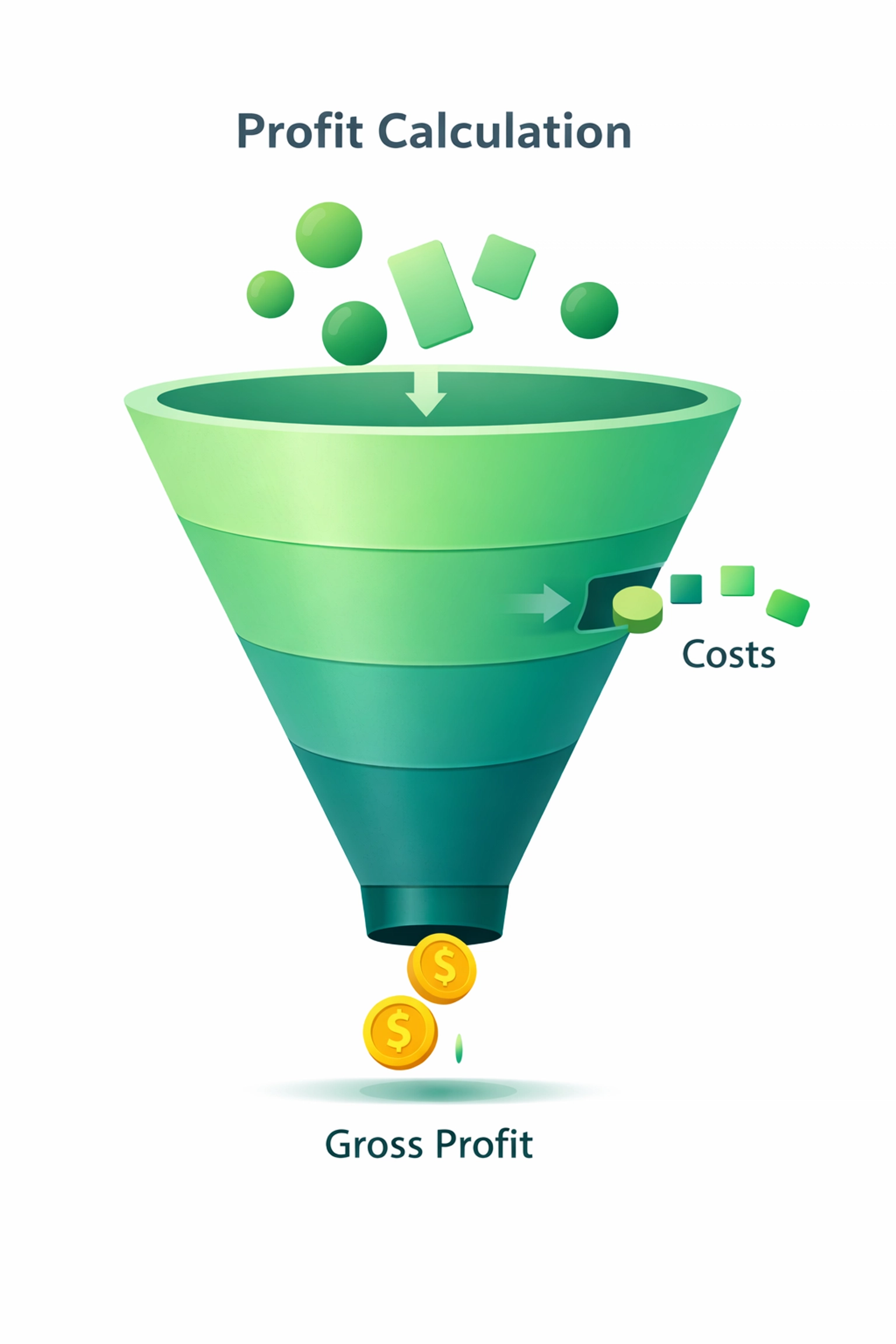
Gross profit margin is the percentage of revenue left after you pay for the stuff you sell. That’s it.
The formula: (Revenue − Cost of Goods Sold) / Revenue × 100
If you sell $100,000 worth of products and it costs you $60,000 to make or buy them, your gross profit is $40,000. Your gross profit margin on sales is 40%.
This isn’t the same as net profit: that comes later after you pay rent, salaries, marketing, and everything else. Gross profit margin just tells you how much breathing room you have after covering your direct costs.
Why This Number Controls Your Entire Business
Your gross profit margin determines whether you can actually run a business or just run a fancy hobby.
Every dollar of gross profit has to cover:
- Rent and utilities
- Salaries (including yours)
- Marketing costs
- Software subscriptions
- Insurance
- Taxes
- Everything else that keeps the lights on
If your margin is too thin, you’re constantly scrambling for cash. If it’s healthy, you have options: you can invest in growth, weather slow months, or experiment with new products.
A real example: A company with $500,000 in annual revenue and a 35% gross profit margin has $175,000 to work with. If that margin drops to 34%, they lose $5,000. That’s a part-time employee. That’s your marketing budget for a quarter. That’s the difference between growing and treading water.
The 1% Rule: Small Changes, Big Impact
Here’s where it gets interesting. At higher revenue levels, each percentage point becomes seriously expensive.
The math at scale:
- $100,000 revenue: 1% = $1,000
- $500,000 revenue: 1% = $5,000
- $1,000,000 revenue: 1% = $10,000
- $10,000,000 revenue: 1% = $100,000
Most businesses operate with margins between 20% and 50%, depending on the industry. Retail might run at 25-30%. Software as a service (SaaS) can hit 70-80%. Manufacturing typically sits around 30-40%.
But regardless of your industry, the principle stays the same: small percentage moves create massive cash flow swings.

When 1% Actually Breaks Your Business
Let’s say you’re running a product business doing $2 million annually with a 32% gross profit margin. That gives you $640,000 to cover all operating expenses.
Your supplier raises prices by 3%. You don’t adjust your prices because you’re worried about losing customers. Your margin drops to 29%.
Result: You just lost $60,000 in gross profit. That’s multiple employees. That’s your growth budget gone. That’s the difference between expanding and laying people off.
This happens constantly. Raw material costs increase. Shipping gets more expensive. Your manufacturer changes terms. And if you’re not watching your percentage gross profit closely, you won’t catch it until the damage is done.
What Actually Affects Your Gross Profit Margin
Understanding the levers that move your margin helps you protect it. Here are the main culprits:
Product costs: Your cost of goods sold (COGS) is the biggest factor. This includes raw materials, manufacturing, packaging, and shipping to your warehouse.
Pricing strategy: Charge too little, and even high volume won’t save you. Charge appropriately, and you create margin cushion.
Product mix: Not all products have the same margin. Selling more high-margin items dramatically improves your overall percentage.
Discounts and promotions: Every discount comes straight out of your gross profit. A 10% sale means 10% less gross profit on those sales.
Returns and damages: These aren’t always tracked properly, but they directly reduce your effective revenue while costs stay the same.
Payment processing fees: Often overlooked, but fees from credit cards and payment processors reduce your actual revenue per sale.
How to Improve Your Gross Profit Margin on Sales
You have three main approaches to boost your margin: lower costs, raise prices, or change what you sell.

Lower Your Costs (Without Sacrificing Quality)
Negotiate with suppliers: If you’re doing consistent volume, you have leverage. Annual contracts often come with 5-10% discounts.
Buy in bulk: Larger orders mean lower per-unit costs. Just make sure you can actually sell the inventory.
Find alternative suppliers: Get quotes from 3-5 suppliers every year. Competition keeps everyone honest.
Reduce waste: Track exactly where materials go. Small inefficiencies compound quickly.
Optimize shipping: Consolidate orders. Negotiate carrier rates. Consider different fulfillment locations.
Quick tip: A 5% reduction in COGS often delivers the same profit boost as a 15-20% increase in sales volume: with way less effort.
Raise Your Prices (Strategically)
Most businesses undercharge. If you haven’t raised prices in over a year, you’re probably leaving money on the table.
Test price increases: Start with your best customers or newest products. Monitor closely.
Bundle products: Selling packages often lets you charge more with less price resistance.
Add value: Improve packaging, service, or features: then charge accordingly.
Segment pricing: Different customers have different willingness to pay. Use it.
A 3% price increase with no cost changes means 3% straight to your gross profit margin. On $1 million revenue, that’s $30,000 additional gross profit.
Change Your Product Mix
Not all revenue is created equal. Focus on products with better margins.
Track margin by SKU: Know exactly which products make you money and which ones don’t.
Promote high-margin items: Put your marketing budget behind products that actually deliver profit.
Phase out low-margin products: Sometimes the best decision is discontinuing products that drag down your overall margin.
If your current mix averages 35% margin, shifting just 20% of sales to products with 50% margin takes your overall margin to 38%: that’s a 3-point improvement without changing a single price.
Track Your Margin Continuously
This isn’t a once-a-year calculation. Successful businesses track gross profit margin monthly: or even weekly.
What to monitor:
- Overall gross profit margin percentage
- Margin by product category
- Margin by sales channel (retail vs. wholesale vs. online)
- Trends over time (are you improving or declining?)
ProCalc.app makes this stupidly simple. Plug in your revenue and COGS, get your margin percentage instantly, and track changes over time.
FAQ: Common Questions About Gross Profit Margin
What’s a good gross profit margin on sales?
Depends entirely on your industry. Software and digital products can hit 70-90%. Retail typically runs 25-50%. Groceries might be 15-25%. What matters more is whether YOUR margin can cover YOUR operating expenses and still leave profit.
How is gross profit margin different from markup?
Markup is calculated on cost (selling price minus cost, divided by cost). Gross profit margin is calculated on revenue (gross profit divided by revenue). A 50% markup equals roughly a 33% margin. They measure related concepts differently.
Can gross profit margin be too high?
Rarely a problem, but yes: if your margin is dramatically higher than competitors, you risk losing market share to cheaper alternatives. Or you’re in a unique position with no competition (which eventually changes).
Should I calculate margin before or after discounts?
After. Always use your actual revenue numbers. If you gave a 20% discount, that’s your real revenue: calculate margin on that.
How often should I calculate my gross profit margin?
Monthly minimum. Weekly if you have high transaction volume or rapidly changing costs. It’s a leading indicator: it tells you about problems before they show up in your bank account.
What’s the fastest way to improve gross profit margin?
Raise prices on your top-selling products by 2-3%. Most customers won’t notice or care, and it immediately boosts your margin. Test it with a subset first if you’re nervous.
The Bottom Line
Your gross profit margin on sales isn’t just an accounting metric: it’s the foundation of your entire business model. That seemingly small percentage gross profit determines whether you’re building something sustainable or slowly bleeding out.
Watch it closely. Protect it fiercely. And remember: in business, 1% really can make or break everything.
Need to calculate your gross profit margin quickly? Try the calculator and see exactly where you stand.
ProCalc.app is available on the App Store as a one-time purchase, with no subscription and no ads: https://apps.apple.com/app/id432321030







Leave a comment
Sign in to post your comment or sign-up if you don't have any account.